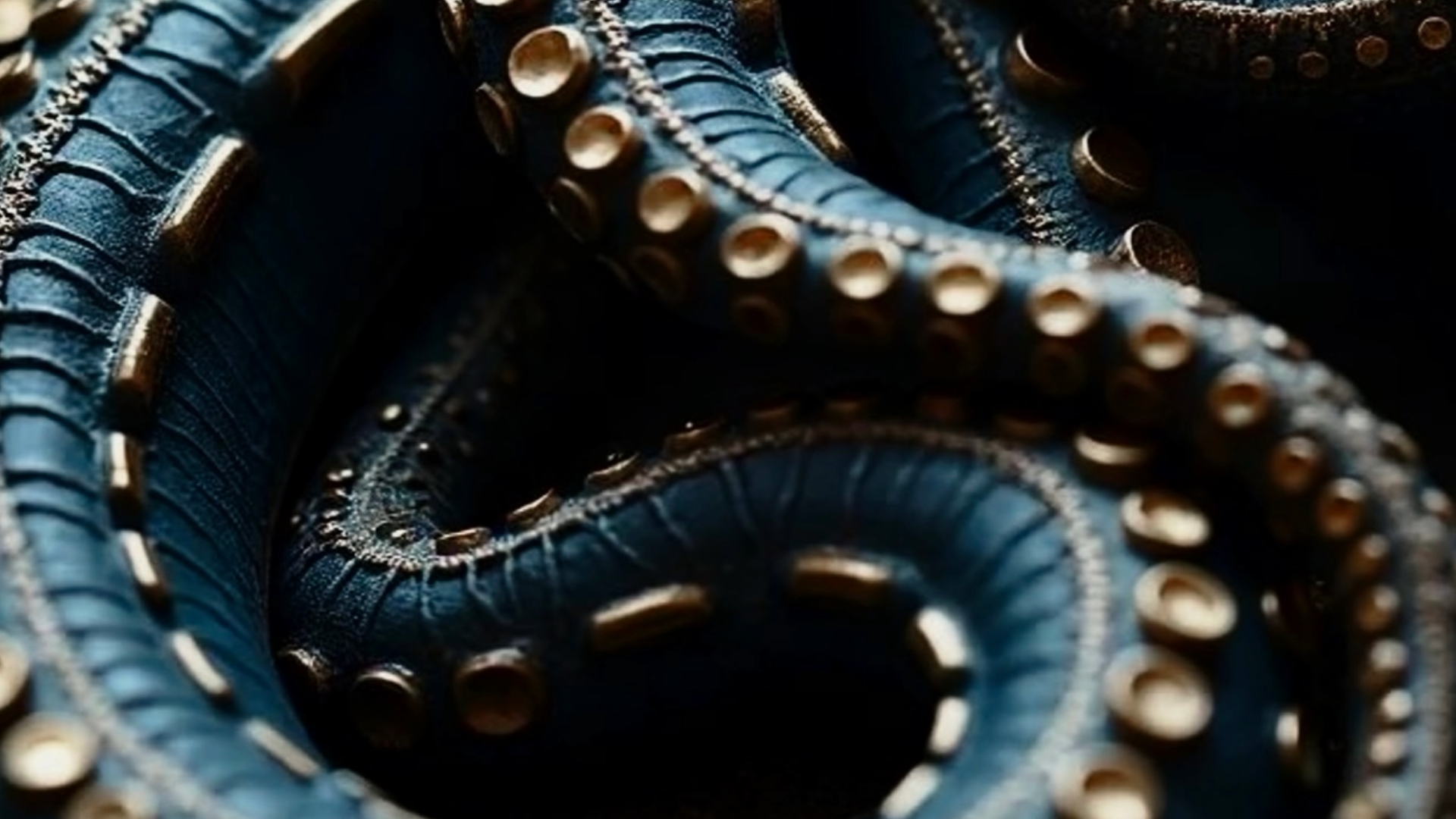
Many works of art begin with a narrative. An artist imagines a story and then creates images to illustrate it. My process often unfolds in reverse.
Rather than beginning with a complete story, I begin with an object.
A scarab. A fragment of architecture. A mirror. A piece of jewelry. A staircase disappearing into shadow. An artifact whose purpose is unclear.
The object arrives first. The narrative follows.
What interests me is not simply the appearance of an object but the questions it generates. Who made it? Why does it exist? What history does it carry? What world produced it? The most compelling objects seem to possess a life beyond their immediate function. They suggest that they belong to something larger than themselves.
A scarab is never merely an ornament. A mirror is never merely a reflective surface. A city is never merely architecture.
Each object becomes evidence.
Evidence of a place, a culture, a mythology, or a memory that may or may not have existed.
This way of thinking shapes both my artwork and my approach to exhibition design. Rather than creating isolated pieces, I am interested in constructing environments in which objects appear to belong to the same imagined civilization. A painting may function as a window into that world. A sculpture may appear as a relic recovered from it. A display structure may become an artifact in its own right.
The goal is not to create a fictional universe in the traditional sense. It is to cultivate the feeling of discovery.
Museums often present objects as evidence of the past. Visitors encounter fragments and are invited to reconstruct a larger story from what remains. A single artifact can suggest an entire culture. A ruined building can reveal centuries of history.
I am fascinated by that process.
The objects that appear throughout my work frequently occupy a space between history and invention. Veiled cities emerge from memory and imagination. Fractured mirrors reflect incomplete truths. Architectural forms appear weathered by time. Relics seem recovered from forgotten places. The familiar becomes strange, while the strange feels oddly familiar.
What matters is not whether these worlds ever existed.
What matters is whether they feel as though they could have.
This approach embraces mystery rather than certainty. Not every question requires an answer. Not every symbol requires interpretation. The most engaging objects often resist complete explanation. They leave space for viewers to bring their own memories, associations, and narratives into the experience.
In this sense, the artwork is only one part of the story.
The viewer becomes an archaeologist.
Each object becomes a clue.
Each exhibition becomes an excavation.
The process of looking becomes an act of discovery.
Through this lens, art is not merely an image to be observed but evidence to be examined. Every artifact points toward a larger narrative beyond the frame. Every object hints at a civilization waiting to be uncovered.
The story is never fully revealed.
Only the traces remain.